by Michael Richards
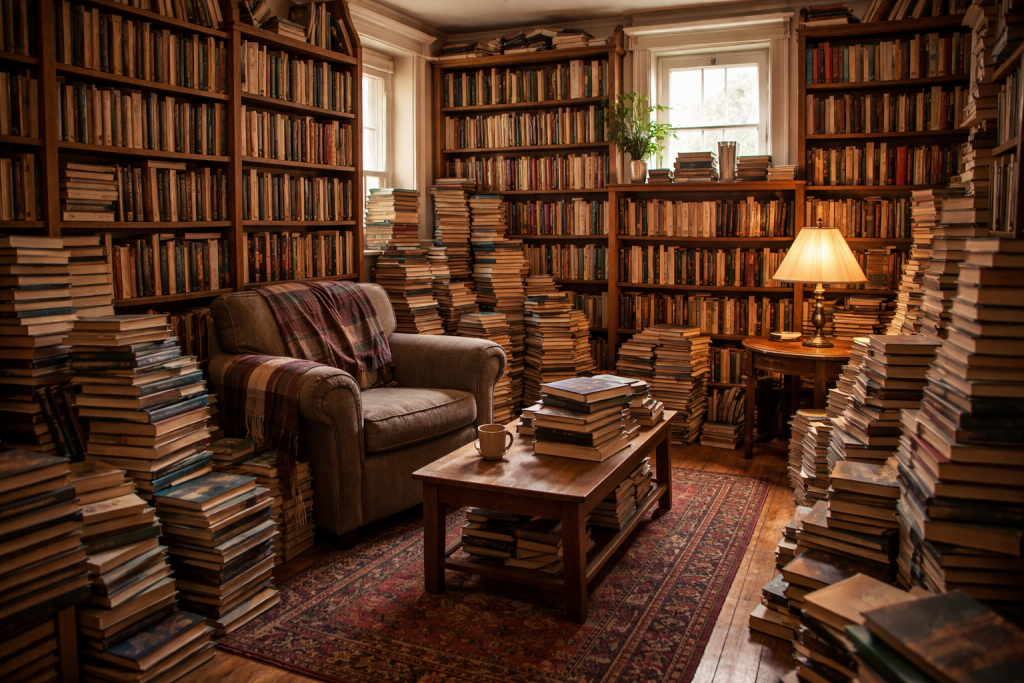
What do you do when suddenly you have a house full of books to deal with? Or maybe it’s just a few shelves full, but you’re not sure what to do with them. All you may know is that they mattered to the person who collected them. If you are not a book collector yourself, the task may be a little daunting. Here are some suggestions, but please note that The Book Collectors Society of Australia (BCSA) is not in the business of buying, selling or appraising books. This is general advice only, and expert advice should be sought in relation to material of significant value.
If you think that you may have to dispose of a large number of books in the future, we urge you to ask their current owner some questions. The answers will help you decide between selling and giving them away.
• Why did you collect these books? What makes the books special to you?
• What would you like done with them? (People often become very attached to their books. Does the collector want you to recover the monetary value, or is it more important that the books go to people who will find them useful? If you are an executor dealing with an estate that includes valuable books, it is also important to bear in mind that there may be legal and capital gains tax implications to your decisions. You may need to seek advice from a qualified legal practitioner or accountant.
• Did you spend much on them? Did you buy them at auction or from specialist dealers? (If books cost a reasonable amount in the past, chances are they are still worth attention, even if fashions have changed.)
• Do you have lists, catalogues, or any records of how much the books cost? Were they insured?
Books that were special to your collector friend or relative may not necessarily be valuable. They may have been prized because they are associated with somebody important to them or were about something dear to their hearts. Perhaps they were the cookbooks they used all their lives, the origins of a family’s culinary traditions? The manuals and guides to a passionate interest, a life-long hobby or career? A house full of books is often an accumulation of quite ordinary books, kept because somebody loved reading and had the space for them.
A great many books have low monetary value. In most cases, the textbooks your relative sweated over sixty years ago are not worth worrying about. Neither are such things as do-it-yourself and self-help manuals, out-of-date software manuals, guides to business success and the thick paperback novels people buy for long flights, although there are exceptions to all these. A first edition of Alcoholics Anonymous’s The Big Book might be worth a good deal. The same is true for certain influential early books on stock trading, and a battered first edition of Baden-Powell’s Scouting for Boys will still be highly sought after. Most children’s books and fantasy paperbacks are not worth much either, yet some are quite valuable. All of this points to the need for expert assistance.
Old or leather-bound also does not necessarily mean valuable, especially if it’s a Bible or a prayer book, unless it really is seriously old, pre-1800, at least. Where was it printed? A copy of the General Standing Orders of 1802, printed in Sydney? You’re in luck. But most common twentieth-century books are unlikely to have high monetary value, and most textbooks and encyclopedias likewise. The same applies to many nineteenth-century books. Good condition is important, and much depends on the topic. You may end up adopting a mixed approach, especially with a large collection – selling some, giving some away, and sending some off to be recycled.
Selling books
Look through the books and put aside anything that looks interesting or unusual for checking. You can find out a lot about the value of most books online. Websites that search across a wide range of selling platforms are particularly useful, such as BookFinder.com, Addallbooks.com and viaLibri.net. We suggest, however, that you treat search results with caution. Remember that they list the asking price and not what you would get if you tried to sell the same book to the same bookseller – and also that it may not be the same edition. A recent set of The Lord of the Rings is not the same thing as the first editions in dust jackets.
Also, booksellers have overheads, and they may already have multiple copies in stock. If a book is reasonably valuable their mark-up may be conservative, but if they are buying a large number of run-of-the-mill books they will generally only be able to offer much less, often on a unit basis. Sometimes, too, the price quoted online is set by an algorithm based on the number of copies currently available rather than a widely-accepted true value. Some websites offer further useful advice, for example https://biblio.com.au/book-value.
Your best guide to discovering if books have significant value will usually be a professional bookseller. One place where you can find such people is through professional associations of antiquarian booksellers (American Antiquarian Booksellers Association, International League of Antiquarian Booksellers, Australian and New Zealand Association of Antiquarian Booksellers) which will guide you to people committed to the ethical standards common across the international book trade. This is also useful if you are looking for somebody who specializes in a particular topic. Many excellent booksellers are not members, however, so you may need to search more broadly to find someone convenient for you. Ask around to see if anybody can recommend someone local. But it’s not a good idea to arrive at their shop unannounced with a carload of books! Some booksellers have particular times when they do appraisals, and they may not be buying when you turn up. Also, many reputable businesses trade online only.
It is a good idea to be able to describe what you have when you talk to anyone, even if it’s only in general terms. Make some lists, perhaps sampling the shelves if the collection is big, or even just take some photos of shelves with titles visible. What sort of books are they? Fiction or non-fiction? What topics? Paperbacks or hardbacks? Are they limited editions? Often you will have to look at the rear pages to discover this: many private press books are individually numbered and may be signed by authors and illustrators.
Are they in good condition?
This is a key question: good booksellers pride themselves in grading books carefully, and different copies of the same title may vary hugely in value, depending on how carefully they have been looked after. Did the previous owner smoke? Are there signs of insect damage? Cockroaches and silverfish have ruined many beautiful books. Look under the dustwrappers: mold and damp may have affected the boards. What booksellers call ‘foxing’, a brownish stain on the paper, may not be a problem: with some books every copy has it. On the other hand, the acidic paper used for much of the 19th century makes paper brittle and a book may flake away as soon as you open it. Have the books been written in or underlined, and if there are attractive plates do they seem to all be there?
Some buyers may be prepared to make an on-site inspection. And there is no reason why you should not approach more than one bookseller, but if you let one person pick out the best books, don’t be surprised if the rest are not worth very much. And as with any market transaction, the more you know about what you have, the better prepared you will be when negotiating with potential buyers.
Apart from booksellers, another possibility is consigning books to auction. You will incur fees and possibly transport costs, but you may get a better result and possibly attract international interest. There are specialist book auctioneers, so do some searching online. Many general auctioneers also handle books, especially those who deal in estates. Contact the auction house and ask for their advice. Often there is general guidance on how to consign lots for sale on their websites. Many people also sell their books online themselves, for example on eBay, but bear in mind there’s a lot of work involved in listing and mailing, plus selling fees.
Donating books
The other possibility for rehoming books is to give them away, which is often the easiest and quickest thing to do. There are many groups likely to be interested in a donation of your unwanted books, and sometimes they are a major source of income for charities, such as Goodwill, Oxfam, or Lifeline Australia Book Fairs and shops. Some communities have recycling facilities which sell books donated to them. Thrift shops often welcome books, and there may be annual sales run by schools, community associations, libraries and churches in your town. Some of these groups will be able to pick up your books if you have a lot of them.
Many of our members treasure books given to them by friends or chosen from their shelves after they died, kept in memory of them. It might be worth making the same offer to your collector’s friends and family. And sometimes libraries will be grateful for a chance to look through the shelves, especially in specialist fields or local history.
Finally, some suggestions for what to do when donating books, or when taking them to a bookshop.
• Pack them lying flat to stop them being damaged and bent when boxes are stacked, and use small boxes. Books are heavy, and charities often have weight limits on what they will ask their volunteers to carry. Recycled wine cartons are ideal for most sizes of books.
• Look through them before you dispose of them, because sometimes people put money, letters and other personal items in their books.
• Don’t tear out pages with the owner’s name: it greatly lessens the value – and an inscription might indicate a significant association, perhaps a gift from the author, or an important previous owner.
• Don’t discard dust jackets just because they are a little untidy. They can add hugely to the value of some books, especially first-edition novels and poetry.
• In-flight magazines and most modern ex-library discards are are among the least desirable items, although some charities will take specialist magazines and sought-after ex-library books in good condition can retain a lot of value. There will always be exceptions to these general principles, in other words.
• And lastly, if you are contemplating the disposition of your own collection, some BCSA members who have gone through the process themselves urge you not to leave it too late! As one of them says, “Downsizing usually means a lot of bending, reaching, lifting and carrying and often up and down stairs (or attic ladders) and this is not a task for most folk over 80. However, the whole process is daunting given that we want to enjoy our treasures and have them in our possession for as long as possible.”
Michael Richards trained as an historian and librarian. He worked at the National Library of Australia and Old Parliament House in Canberra where he was in a team which established the Museum of Australian Democracy. Michael has a particular interest in the history of printing and typography and is a letterpressprinter in a small way. He is a member of the Book Collectors’ Society of Australia.