By Marshall Hicks
At a North Carolina estate sale in March 2026, I found a worn book with its spine covering missing. Dark puce boards, decorated with silver-gray Egyptian ornament, enclosed an extraordinary inscription: Charles R. Hale had addressed the volume to Washington Irving at Christmas 1858.
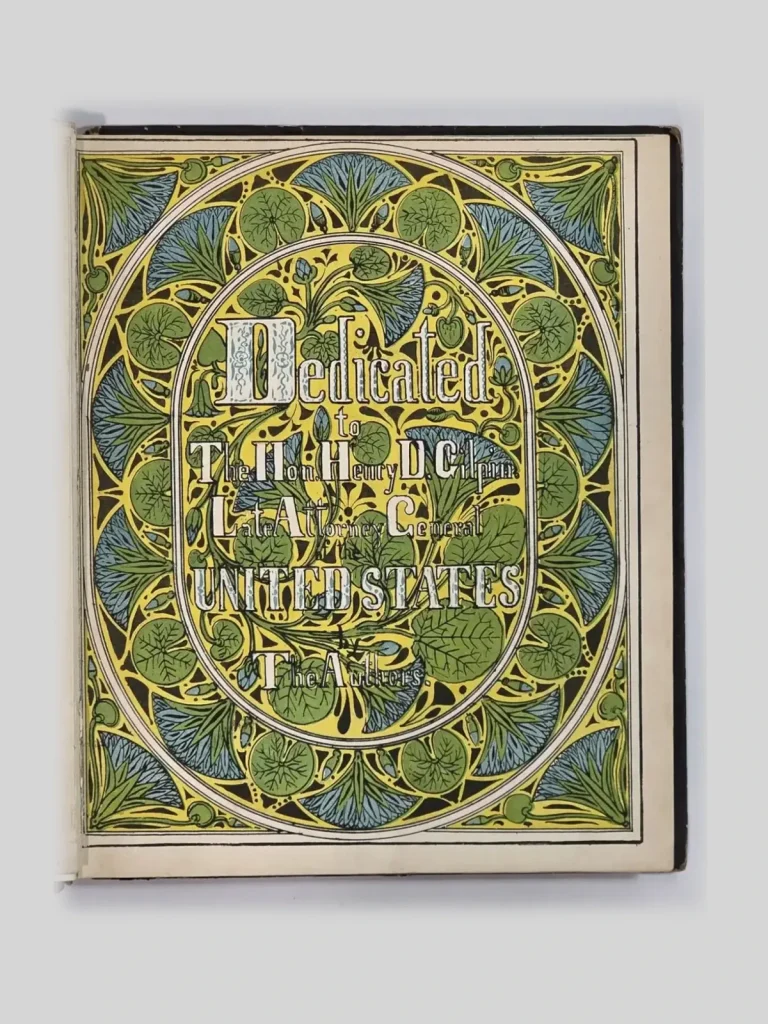
The book was the Philomathean Society’s Report on the Rosetta Stone, prepared at the University of Pennsylvania by Charles Reuben Hale, Samuel Huntington Jones, and Henry Morton. (The full title is Report of the Committee Appointed by the Philomathean Society of the University of Pennsylvania to Translate the Inscription on the Rosetta Stone, 1858.) The Rosenthal lithographic establishment reproduced its handwritten text and colorful designs. But the inscription posed a more personal question: what connected this young author in Philadelphia with Irving at Sunnyside?

An Aunt, a Nephew, and a Neighbor
The answer began to emerge from other surviving copies. At Case Western Reserve University, a first edition bears George D. Morgan’s presentation to his brother, the Reverend William F. Morgan, at New Year 1859. Following that name led to George Denison Morgan and his wife, Caroline Amelia Hale Morgan.
Caroline was Charles Reuben Hale’s paternal aunt, the sister of his father, Reuben Charles Hale. She and George were Irving’s neighbors near Sunnyside in Tarrytown. The family connection supplied a plausible personal route between the student author and the celebrated writer.
Then another book made the relationship tangible. Sotheby’s documented an 1854 edition of Irving’s The Sketch Book of Geoffrey Crayon, Gent., inscribed by Irving to “Mrs George D Morgan” at Sunnyside on December 25, 1856. He called himself “her friend.” Two years before Hale inscribed the Rosetta Stone Report for Irving, Irving had given a Christmas book to Hale’s aunt.
Caroline’s own Rosetta Stone Report survives at the University of Delaware. Hale inscribed it to her as his “affectionate nephew,” also at Christmas 1858. Three surviving Reports and Irving’s separate Sketch Book now brought a family’s exchange of books into view: Hale to his aunt, Hale’s inscription to her famous neighbor, and George Morgan’s gift to his brother.
Finding that connection was a revelation. These were people who knew one another and exchanged books. The evidence makes Hale’s inscription to Irving historically intelligible. Whether Irving received this particular volume, and how it eventually reached North Carolina, remain questions for further research.
One Discovery Becomes a Census
Comparing the estate-sale book with other copies also opened a second investigation. Four hundred Reports were printed in 1858 and six hundred in 1859: a thousand books whose surviving examples preserve different bindings and ownership histories.
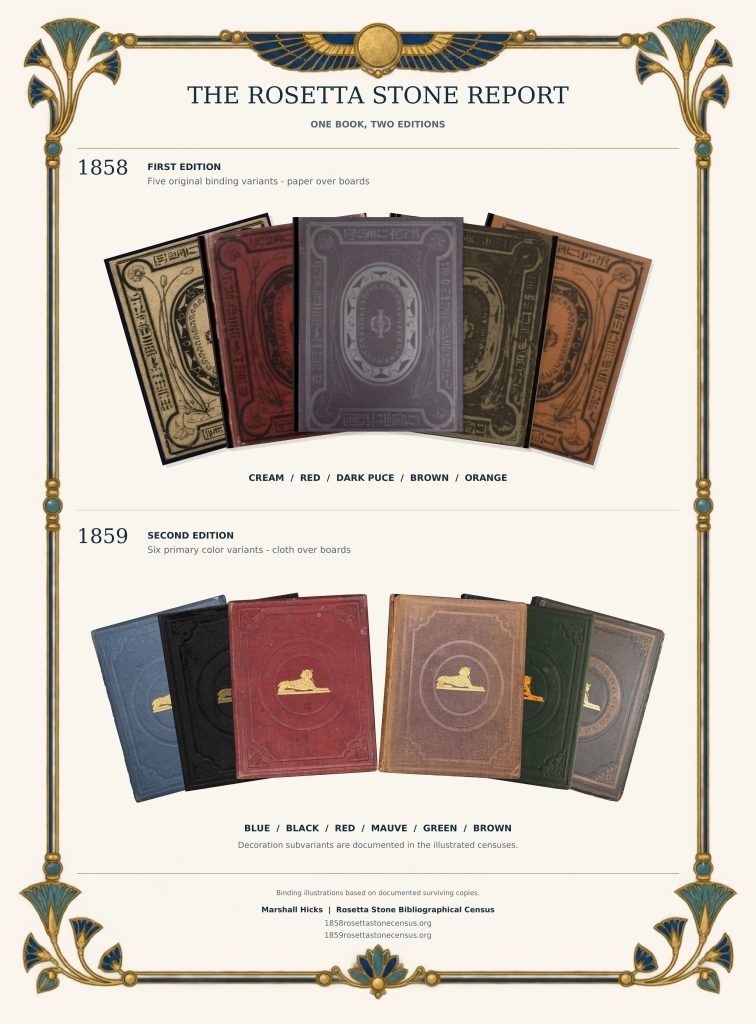
Five original 1858 binding variants are documented: cream, red, brown, dark puce, and orange, all in decorated paper-covered boards. The 1859 edition has six primary cloth colors: blue, black, red, mauve, green, and brown, with further differences in decoration. The accompanying fans show those appearances; individual photographs and records appear in the online censuses.
Other trails remain open. Alexander von Humboldt acknowledged receiving the Report and placing it in Dr. Brugsch’s hands. His copy has not been located in the census. Another surviving book, dated inscription, or old bookseller’s catalogue may supply the next connection.
I welcome reports of copies and photographs of bindings, title pages, inscriptions, and ownership marks. Private owners can remain anonymous. What began with one inscription has become a search for the books themselves and the people whose lives they connect.
The illustrated censuses are freely available:
1858rosettastonecensus.org
1859rosettastonecensus.org
Reports of copies and related material: rosettastonecensus@gmail.com
Marshall Hicks is a book collector and independent researcher who created the illustrated bibliographical censuses of the 1858 and 1859 Rosetta Stone Reports. Working with librarians, collectors, and booksellers, he traces surviving copies through their bindings, inscriptions, bookplates, and ownership histories.